 English
  Tiếng Việt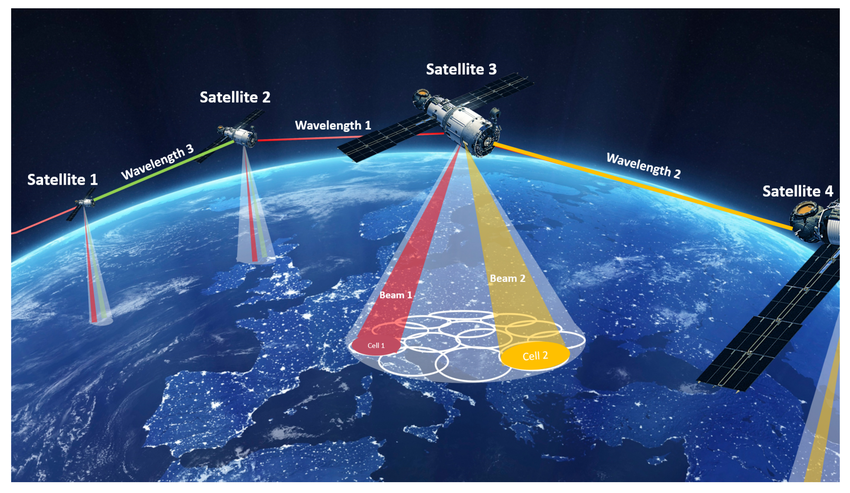
1. Overview of Optical Laser Link Technology in Satellite Networks
Trong lĩnh vực viễn thông vệ tinh, truyền dữ liệu truyền thống chủ yếu dựa trên sóng radio tần số cao (RF). Tuy nhiên, với sự gia tăng về nhu cầu băng thông và độ trễ thấp, các hệ thống vệ tinh hiện đại đã chuyển dịch sang công nghệ liên kết laser quang học (Optical Inter-Satellite Links – OISL). Đây là công nghệ tiên tiến được ứng dụng trong mạng vệ tinh Starlink của SpaceX để tối ưu hóa hiệu quả truyền tải dữ liệu trên quỹ đạo Trái Đất thấp (LEO).
Optical laser links use narrow laser beams capable of transmitting data with extremely high bandwidth, while minimizing wave interference and improving information security compared to traditional radio wave transmission methods.
2. Operating Principles of Optical Laser Links Between Starlink Satellites
2.1 Structure and Equipment
Each Starlink satellite is equipped with highly precise laser transmitters and receivers, allowing the emission of narrow, stable, and accurately directed laser beams to adjacent satellites in orbit. These beams transmit data through the conversion of digital signals into laser light.
2.2 Mesh Network Data Transmission
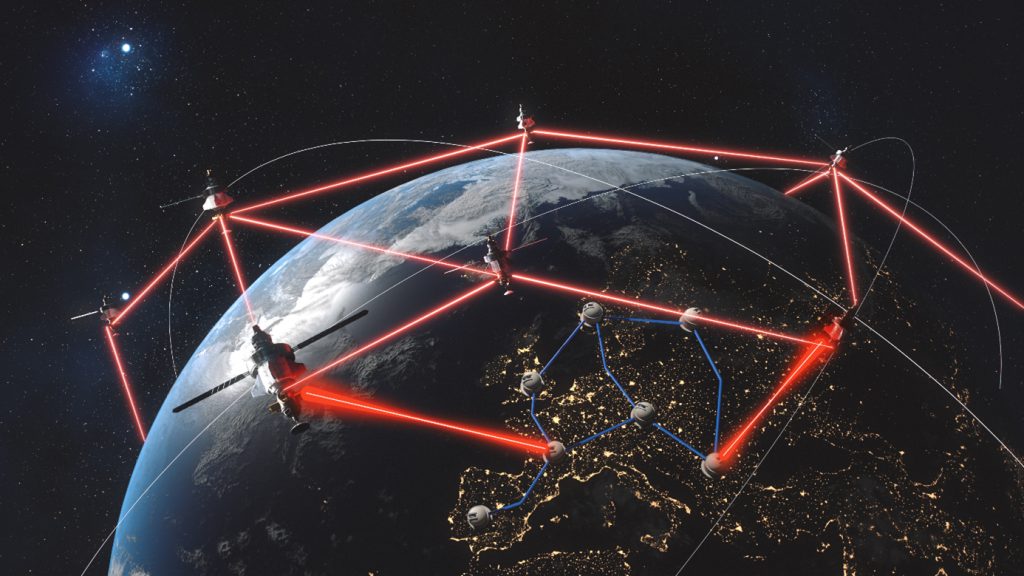
Optical laser links enable Starlink satellites to connect multidimensionally, forming a peer-to-peer mesh network. Data can be transmitted through various satellites before being relayed to ground stations, optimizing transmission paths, minimizing latency, and enhancing the fault tolerance of the entire system.
2.3 Advantages Over Ground Station Data Transmission
Direct data transmission between satellites using lasers reduces reliance on ground stations, allowing the Starlink network to cover wider areas, including geographic regions where ground stations cannot be established, while also minimizing latency caused by signal transmission to and from the ground.
3. Technical Advantages and Benefits of Inter-Satellite Laser Technology
3.1 High Bandwidth and Data Transmission Speed
Optical lasers allow data transmission at speeds of up to tens of gigabits per second, far surpassing traditional radio waves. This enables Starlink to provide high-bandwidth internet services, meeting the growing data demands of users.
3.2 Low Latency and High Stability
Direct laser links between satellites help minimize physical distance and intermediate steps, significantly reducing latency and ensuring stability during data transmission.
3.3 Security and Interference Resistance
Narrow, precisely directed laser beams are difficult to eavesdrop on or affect by electromagnetic wave interference compared to radio wave transmission. This is a crucial advantage for applications requiring high security.
3.4 Self-Adjusting and Redundancy Capability
The network can self-adjust data transmission paths when a satellite or link encounters issues, automatically rerouting signals through other satellites, increasing availability and reliability.
4. Technical Challenges of Inter-Satellite Laser Technology
4.1 Laser Beam Control Accuracy
Starlink satellites move at very high speeds (approximately 7.8 km/s), so the system needs to control the laser beam with nanometer precision to maintain a stable link in the volatile space environment.
4.2 Impact of the Space Environment
Sudden high and low temperatures, cosmic radiation, dust, and other physical factors can affect the performance of laser devices and control systems.
4.3 Power and Size Limitations
The laser transmitter on the satellite must be compact, consume low energy while ensuring strong transmission power, which poses very high technical requirements in device manufacturing.
4.4 Complex Network Management
The network system needs to efficiently manage thousands of satellites with tens of thousands of laser links, including coordination, load balancing, redundancy, and real-time software updates.
5. Supporting Technology Components
-
Optical laser transceiver: Using high-power laser diodes, sensitive photodetectors to transmit and receive signals.
-
Laser beam steering system: Sensors and servo motors help maintain the laser beam closely aligned with the target satellite under all orbital conditions.
-
Encoding and decoding algorithms: Ensure data transmission is securely encrypted and accurately decoded even in the presence of interference.
-
Distributed network management software: AI and network optimization algorithms help handle routing, load balancing, and ensure reliability.
6. Future and Development Prospects
-
Research and development of the next generation of satellites with higher power lasers, multi-channel, and more compact designs.
-
Application of AI technology in controlling and predicting laser link failures, automatically optimizing satellite networks.
-
Integrating laser satellite networks with 5G/6G and IoT technology to support a variety of communication services and smart connectivity.
-
Expanding laser-linked satellite networks for deep space missions, interplanetary communications.
7. Conclusion
Optical laser link technology between Starlink satellites is a revolutionary breakthrough in the field of space data transmission. With high-speed transmission capabilities, low latency, and superior security, this technology not only enhances the efficiency of satellite networks but also opens a new era for global communications.
Despite facing many technical challenges and harsh environmental conditions, inter-satellite lasers are expected to continue to be developed and become an indispensable technological foundation in the telecommunications ecosystem of the 21st century.